
When Sonder Enters the Chat
Originally published on The Strategic Ampersand Substack · 4/30/26 · Read on Substack
Walk with me.
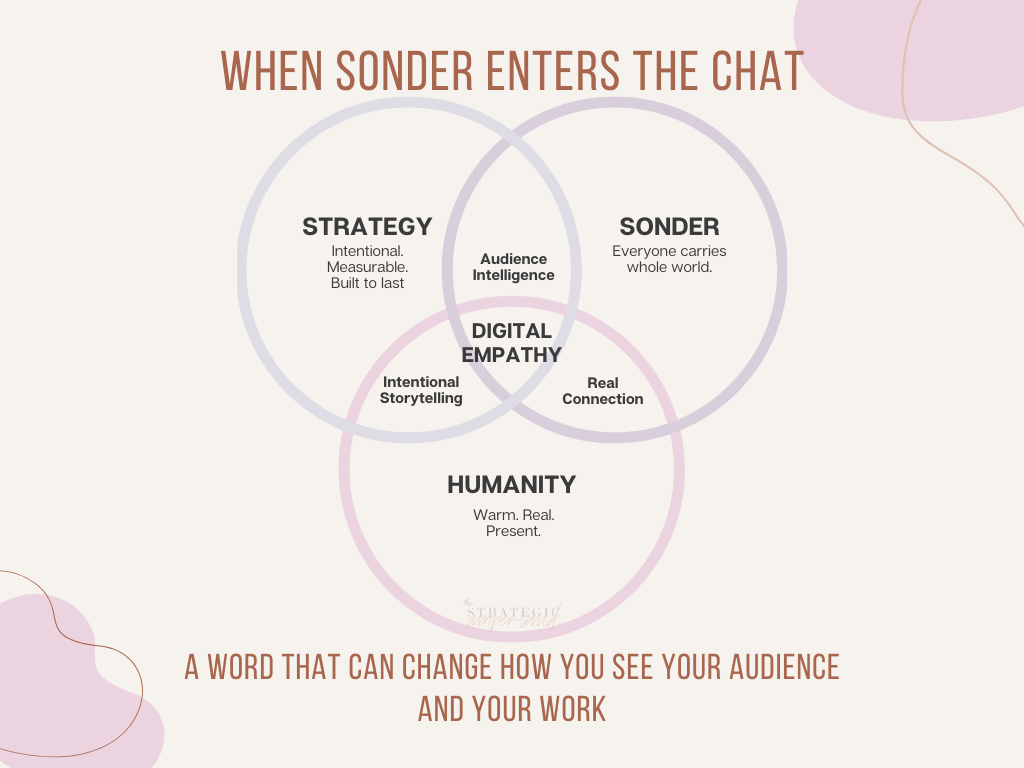
I’ve been thinking a lot about a word I was recently introduced to: sonder (noun); the realization and understanding that all other people have lives as complex as one’s own. It was first used by John Koenig, an American author, in The Dictionary of Obscure Sorrows, a website he started in 2009 and in 2021, published a book. Merriam Webster describes Koenig’s work as “a collection of words coined to describe feelings, emotional states, etc., for which the English language seems to lack a current word.”
I’ve also been thinking about walkers. More specifically the Boston Marathon walkers.
And Nike’s recent (massive) flub.
If you were online, scrolling through your platform of choice, you probably saw it: Nike’s activation at a local store ahead of this year’s Boston Marathon and the unmistakable message it sent - and the backlash that followed - to the participants who walked the course. The ones who trained for months, possibly raised money for the race or a cause, and showed up to do the marathon on their own terms. Yet their pace wasn’t fast enough to matter to the brand whose mission states: “To bringinspiration and innovation to every athlete* in the world. *If you have a body, you are an athlete.”
Sonder. Yep. There’s that word again. Let’s take another lap.
Now, to give Nike the benefit of the doubt, the marketing team didn’t set out to be dismissive. They were focused on the runners and the act of running. Probably wanted to be humorously wry. However, possibly as the brainstorming progressed, Hubris entered the chat and Empathy was removed. And the walkers became the punchline.

Photo by Brett Wharton
This has been sitting with me. Not because it’s surprising; brands fumble. But it reflects where we are right now. There’s a gap between what brands say about empathy, the importance of their employees and/or customers; and what they actually practice, what we see in their actions. It can feel as wide as a 26.2-mile stretch.
And that's when Sonder enters the chat. Well, my chat.
Last year, I felt like I was treading water in a storm trying to keep things afloat. It was one of those (year-long) moments I kept telling myself this too shall pass, while watching people around me also struggle, all in their own ways. Seeing anxiety rise with the daily barrage of “unprecedented” news, the economy sliding, the state of our nation – and the world – faltering; and feeling the impacts all around. For me, it meant pausing on what I could, including here, knowing I could come back at some point.
And that “some point” is now. Over the past year or so, I’ve also watched businesses perform a similar pattern on repeat: invest in the aesthetics of empathy without actually putting it into consistent, competent practice. And while I know on the street-level, there’s a sense of empathy and compassion – we see it every day in Instagram - we as marketers, as brand gatekeepers, need to remember the importance of sonder.
I’ve spent the last decade-plus building brand programs, running campaigns, writing copy, directing creative, and thinking constantly about what it means to actually connect with an audience rather than just reach one. To recognize pain points is to acknowledge someone’s actual lived experiences. To build a content strategy around those experiences is to create confidence not just in the brand, but in the individual themselves.
To root for those who may be the walkers, with their own stories, their own passions, their own heartaches. To re-envision what sonder looks like in a strategy.
Creating a campaign that shares a sense of humility, of realness… a sense of I-see-you to audiences is hard.
It’s hard to create and craft a message that applies to your key audience target, while remaining approachable to those who are interested. And all while acknowledging your brand isn’t for everyone. Not everyone wants to run in a marathon.
But I’m not talking about a watered-down version of a brand. I’m talking about being authentic to the brand itself: the mission statement, core values, acknowledging its growth and journey, sharing its good fortune with its employees, and being a champion of its clientele. And it owns its mistakes and puts in the work to rebuild trust.
That’s what this newsletter is going to be about.
Not marketing tips. Not growth hacks. Not here are five things you can do this week. (Well… maybe some once in a great while.) It will be something closer to: here’s what I’ve observed and learned from doing this work for 15+ years across 70-plus brands. Here’s what empathy in marketing could look like when it’s steeped in the strategy on purpose. And here’s what it looks like when it isn’t - such as the case on Boston’s Newbury Street.
Over the years I’ve held a specific belief: the best marketing lives at the crossroads of strategy and humanity. It's what I call a “Strategic Ampersand” - a reminder marketing can be both effective and candid, genuine and strategic, human and measurable. You don't have to choose. It’s the “and.” The brands worth building are the ones people actually want to support - to be a part of - because they feel seen and valued. They believe they matter.
So: welcome back, if you’ve been here before. Welcome, if you’re new. I’m glad you’re here.
Let’s celebrate the walkers - and runners - in the race.
And thanks for walking with me.


A friend paused mid-scroll to ask if a post's "low" likes were being throttled. It had 15K likes and 2K shares — that's not low. That same night, a Ted Lasso episode showed the exact same problem: a commercial with massive online support yet a less-than-desired attendance at a match. Here's what 100,000 likes actually look like translated into a real crowd — and why the number that matters isn't the one everyone's counting.