
What Beyoncé's Concert Producer Knows That Most Brand Campaigns Miss
Originally published on The Strategic Ampersand Substack · 6/11/26
Apologies to clients who read this because they know this example by heart but now.
Imagine you’re at a concert. The opening act finished a little while ago and the stagehands have tuned and placed the last guitar in its stand. You’re waiting for the main act to take the stage. The lights go dark. The crowd gets quiet; then someone whistles and cheering starts.
The band walks on the stage, settles into their spots, and familiar music starts pulsing through the venue. The backup singers walk to their microphone stands. The crowd gets even more electric.
The stage lights strobe as dancers take the stage, moving to the rhythm. Then - BOOM - Beyoncé (or Taylor or your musician of choice) is center stage, fully in command.
The show is unforgettable. Not just because of the headliner alone; but thanks to multiple elements, all carefully sequenced - some back of house, others on the stage - moved together, delivering an incredible moment and show.
That’s a campaign.

Photo by Brunxs Monochrome
THREE KEY ELEMENTS
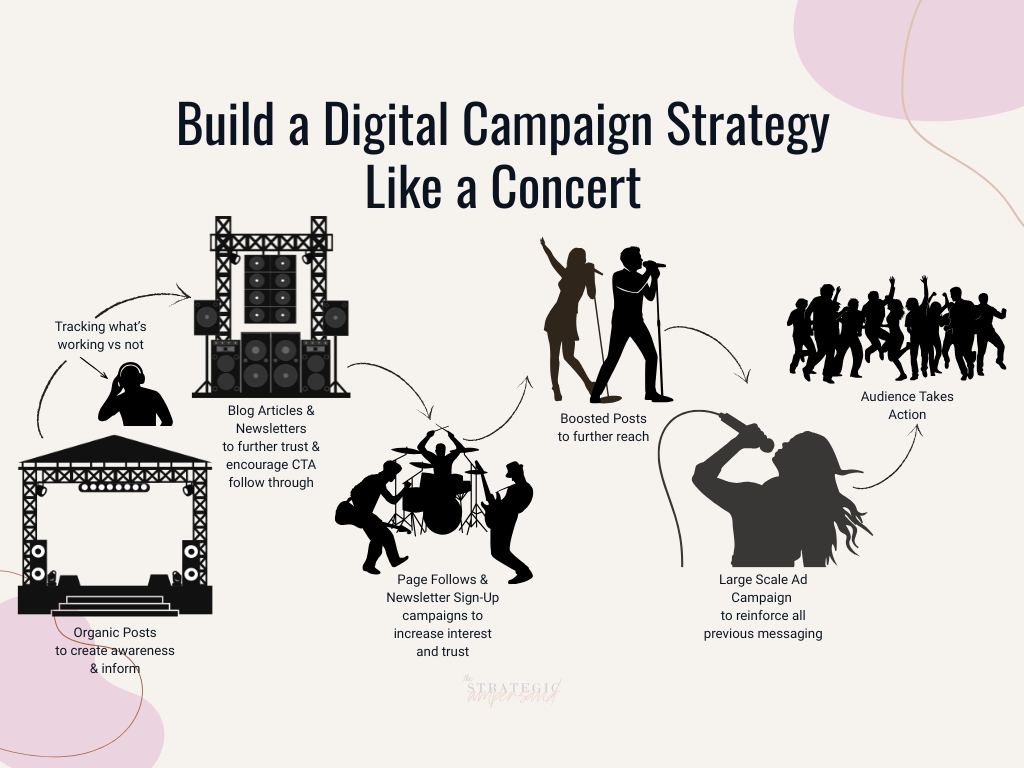
Every strong digital campaign has three key layers working in concert. (Pun absolutely intended.)
The Stage: Organic Content Campaign
This is your foundation. Regular posts, brand voice, relationship-building newsletters; basically it’s your presence on the platforms where your audience lives. Organic content creates the environment your campaign launches into. It’s what your existing audience sees consistently; and what new audiences encounter while they’re scrolling.
Without it, you’re asking Beyoncé to perform on an upside-down bucket with no lights, no sound system, and without a (majority of the) crowd who knows the songs. I mean, it could still be memorable in some ways, but it’s not going to be the full experience.
The Band & Dancers: Boosted Posts
Boosted posts extend your organic content’s reach beyond your existing followers. They’re not a full ad campaign; they’re amplification. They take something already performing well organically and give it a wider runway. Think of them as the band who singles to the crowd the headliner is about to arrive on stage. They’re the dancers doing the work, building energy, making the headliner’s entrance all the more memorable.
The Headliner: Paid Ad Campaign
This is your targeted, goal-driven paid effort - the campaign with defined audiences, specific objectives, and a budget built to deliver measurable results. It reaches people who’ve never heard of you, at the exact moment they’re most likely to be receptive. It’s Beyoncé, center stage, fully in command. However: this is also happening due to the stage, lights, and all of the rigging; the band that’s right on cue with the next note or song; and the dancers who perform flawlessly - the moment works because everyone is working in unison.
This is also when you make the ask in your newsletter. Prior to this moment, it’s relationship building, earning readers’ trust, and now: the offer with a clear CTA.
Beyoncé can throw down an incredible show on her own. So can the backup singers, dancers, and band. But put them all together? That’s a show people will talk about for years.
You might be thinking “Do people really talk about campaigns like they do shows?”I’m here to say: Absolutely.
Folks love a good campaign, especially one that draws them in. A countdown to a launch? If you’ve given it the necessary attention, crafting and building interest - then yes. The key: stop building a campaign as if it’s only about the ad itself.
WHY THE SEQUENCE MATTERS
Here’s where a lot of campaigns stumble: brands go straight to the headliner, or think they don’t need to create a runway with their posts, newsletter, SMS texts, or boosts. They launch a paid campaign before building the stage; no consistent organic presence, no brand voice the audience recognizes, no foundation of trust to land on. The newsletters are constant asks. The ad runs. People click. They arrive somewhere that doesn’t match the promise.
And as internal powers that be look around, they think the effort was wasted because the campaign underperformed. It’s not because the targeting was wrong. It’s because the headliner was forced onto the stage as the stage was still being built.
The sequence matters as much as the elements themselves. Drafting a campaign timeline can look like this:
4–6 weeks out: Organic content starts building awareness and anticipation. You’re not selling yet; you’re showing up, building presence, earning a place in the feed. Smaller ads are launched, encouraging folks to follow the feed and sign up for a newsletter (don’t forget to have a new subscriber funnel in place to establish a relationship). Teaser organic posts are starting to take place.
2–4 weeks out: Boosted posts extend your reach. You’re amplifying what’s already resonating and warming up audiences who don’t know you yet.
24-72 hours in advance: reward your subscribers with a sneak peak, advance orders with a keyword, or a special landing page for them to get the inside scoop. The reward is what hooks people in.
Launch window: The paid campaign goes live, reaching targeted audiences with a clear message and a clear ask - landing on a brand they’ve already encountered, even if they didn’t notice it at the time.
Post-launch: Organic content sustains the momentum, while testimonials, partners and collaborators, and user-generated content (UGC) tagging helps keep interest rolling. The campaign ends but the relationships don’t.
WHAT THE DATA TELLS YOU
Here’s the part that’s easy to underestimate: the data from your paid campaigns doesn’t just improve the next campaign. It improves everything. What keywords your audience searched. Which messages made them click. What they did - or didn’t do - when they arrived. That’s not just ad intelligence. That’s organizational intelligence. It informs your content strategy and product messaging. It’s an improved grant narrative if you’re a nonprofit. It’s a better pitch if you’re in sales. You start building a library of what works and what needs to be improved – and what can be tossed.
The brands and organizations treating their paid campaigns as isolated line items miss this entirely.
The ones treating the whole system - organic, boosted, paid - as a connected framework use every campaign to get smarter about their audience. Which means better content, better campaigns, and better outcomes across the board.
Your cost per engagement (CPE) improves. Your audience is more aware. Your next show (errr… campaign) is better than the last.
Not every campaign needs a Beyoncé-level production budget. But every campaign needs a stage. It needs a band. And it needs a headliner.
Build the entire experience.

"My buyers don't need social media." "It's full of noise and nonsense." I've heard versions of this sentence from a lot of smart, experienced people - and most of the time, it's a personal opinion cosplaying as a strategic decision. Here's how to tell bias from data, and why it matters.